


NASA Spacecraft Discovers Huge New Crater on the Moon
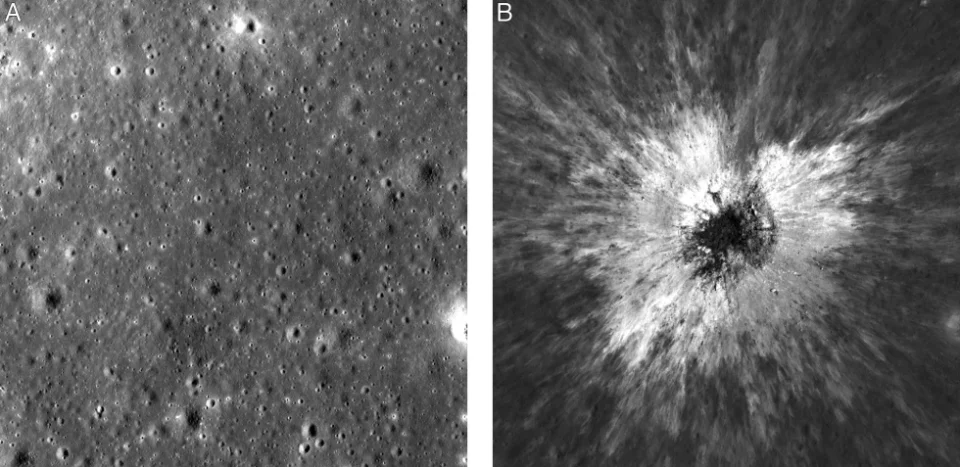
Scientists have discovered a massive new impact crater on the Moon that formed after a powerful collision nearly two years ago but went unnoticed at the time.
The newly identified crater measures about 728 feet (222 meters) across and reaches a depth of up to 141 feet (43 meters). Researchers say it is larger than Rome’s Colosseum and represents the biggest known impact crater created in recent times anywhere in the solar system.
Lunar Crater Formed by Powerful Impact
NASA’s Lunar Reconnaissance Orbiter (LRO) detected the crater on the Moon’s near side in May 2024, shortly after an incoming fragment from an asteroid or comet struck the lunar surface.
The impact was not detected in real time by telescopes operating on Earth or in space.
Researchers estimate that an impact of this size occurs only about once every 132 years, making the discovery an unusually valuable opportunity for scientists studying how objects collide with the Moon.
Two studies about the discovery were published Wednesday in the journal Science Advances.
Discovery Remained Hidden in NASA Data
Although the LRO captured images of the affected region, the discovery was not immediately recognised.
The spacecraft’s wide-angle images remained unidentified within a large volume of data until August 2025.
NASA subsequently collected higher-resolution images of the area during the following autumn. Scientists confirmed the new crater earlier this year.
The researchers described the event as a statistically rare observation that could provide valuable information about lunar impacts.
Crater Named After Lunar Scientist
The newly discovered feature has been named after Thomas McGetchin, a former director of Houston’s Lunar and Planetary Institute.
At approximately 222 meters wide, the crater is around three times larger than the previous record-holder discovered by NASA’s Lunar Reconnaissance Orbiter about a decade ago.
The Moon’s surface contains countless impact marks dating back billions of years, including some of the largest known impact structures in the solar system.
One of the Moon’s ancient impact basins extends for more than 1,500 miles (2,400 kilometers).
Discovery Could Help Future Lunar Missions
Scientists say the recent impact provides a rare chance to study how large objects affect the lunar surface.
The timing is particularly significant as NASA prepares for future lunar missions and plans involving a sustained human presence on the Moon.
Observations of newly formed craters can help researchers better understand the lunar environment and the risks posed by impacts as future spacecraft and astronauts operate on the surface.
