


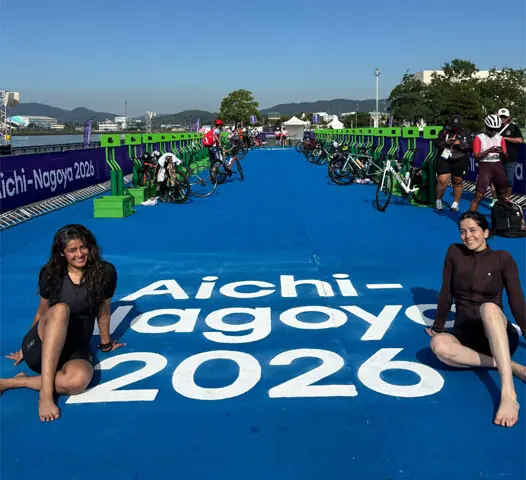
Pakistani Women Triathletes Break New Ground at Asian Games, Call for Better Support
Sports Correspondent: Imran Sohail
Pakistan’s first women triathletes at the Asian Games have opened a new chapter in the country’s sporting history, with Sana Arif and Anisha Ali representing the nation in Japan and highlighting the need for stronger training facilities, equipment and financial support.
For Sana, reaching the continental competition was the result of determination and a relatively short journey in the sport. Born in Kuwait, raised in Lahore and later returning to Kuwait, she learned to swim in 2021 before going on to complete three Ironman 70.3 races. Each event combines a 1.9-kilometre swim, 90.1 kilometres of cycling and a 21.1-kilometre run.
Her opportunity to represent Pakistan came while she was visiting the country on holiday. A friend informed her about trials for the Asian Games triathlon team, prompting her to take part alongside other athletes with different sporting strengths.
Sana’s ability to swim, cycle and run gave her an advantage in a discipline that demands proficiency in all three areas. About a week after the trials, the Pakistan Triathlon Federation informed her that she had been selected for the national team.
Her selection marked a significant milestone, as Pakistan sent women triathletes to the Asian Games for the first time. Sana competed alongside Anisha, a 26-year-old athlete from Hunza, while the men’s contingent included Ali Hassan, Mohid Sadiq Lone and Muhammad Mustaghis Noor.
Anisha arrived with experience in several sports, including judo, martial arts, rowing, boating, tug-of-war and fencing. However, triathlon required her to develop skills across swimming, cycling and running at the same time.
Growing up in Gilgit-Baltistan, she said, had helped her develop a willingness to face difficult challenges. That attitude became particularly valuable as she prepared for an international competition in a sport that was relatively new to her.
Despite the importance of their selection, Sana said much of her preparation took place independently. The federation’s president remained in contact with her, offering guidance and monitoring her progress, but a comprehensive national high-performance training programme was not available.
Triathlon requires specialised coaching, technical preparation and suitable equipment for three separate disciplines. Without a structured support system, much of the responsibility fell on the athletes themselves.
The Pakistani team began building stronger relationships after arriving in Japan. Although some members had met during the selection trials, they had little time to get to know one another before the competition.
Sana said the athletes supported each other throughout the event and understood the level of competition they faced. Although Pakistan’s team had fewer resources and less experience than many rivals, she said the athletes remained determined to finish their races.
Meeting competitors from other countries also proved encouraging. Some international athletes had extensive experience and access to professional training programmes, but their advice helped Sana manage the pressure of competing on such a major stage.
She was particularly reassured when she explained that the sprint format differed from the longer-distance races she usually contested. Other athletes encouraged her and reminded her that representing Pakistan at the Games was itself an important achievement.
The experience also left a positive impression on Sana regarding the arrangements in Japan. The triathlon team was based in Gamagori, where accommodation was close to the competition venue and beach. She praised the facilities, security and hospitality, including food arrangements for Muslim athletes and the availability of vegan options.
Nevertheless, competing at the Asian Games brought a mixture of excitement, stress and anxiety. Pakistan did not secure a medal, but Sana said the experience offered valuable lessons about international competition and the preparation required to perform at that level.
Her main concern is that Pakistan must invest in triathlon well before major competitions rather than provide support only in the months leading up to an event.
She highlighted the need for appropriate equipment, financial assistance and consistent training. According to Sana, Pakistani athletes competed using rented bicycles, while the tri-suits supplied to them were not suitable for the demands of the sport, including the need for appropriate technical fabric.
She believes it is difficult to expect international-level results without providing athletes with the resources needed to train and compete effectively.
Anisha also stressed the importance of creating better opportunities for women in sport. She said more Pakistani women were taking part in athletics, but many talented girls, particularly those living in remote, rural and mountainous areas, continued to face barriers.
Limited access to facilities, qualified coaches, financial resources and safe training environments can prevent promising athletes from developing their potential. Anisha believes that seeing Pakistani women compete internationally can also encourage younger girls to consider sport as a realistic career or personal ambition.
The experience of Sana and Anisha reflects a wider challenge for Pakistani sport. Athletes often reach international competitions through personal commitment, sacrifice and financial contributions, but sustained success requires organised development programmes and long-term investment.
For Sana, the Asian Games were both an achievement and an opportunity to understand what must change. Competing against experienced international athletes gave her a clearer picture of the standards required to become competitive at the highest level.
She said the response from people in Pakistan had largely been positive, despite criticism that sometimes follows athletes who return without medals. Sana believes that public opinion should not overshadow the effort required to reach an international competition.
The participation of Pakistan’s first women triathletes at the Asian Games has established an important starting point for the sport’s development in the country. Their appearance demonstrated that Pakistani women can compete in a demanding endurance discipline, even when they have fewer resources than many of their international rivals.
The challenge now is to turn that first step into a sustainable pathway for future athletes. Consistent coaching, modern equipment, financial support and opportunities to compete internationally could help the next generation arrive at the starting line better prepared.
For Pakistan’s women’s triathlon programme, the long-term goal is not simply participation. It is to create the conditions in which athletes can compete for stronger results and build on the foundation established in Japan.
