


Pakistan Hockey: Asian Games Bronze Offers Hope, but Major Challenges Remain
Sports Correspondent: Imran Sohail
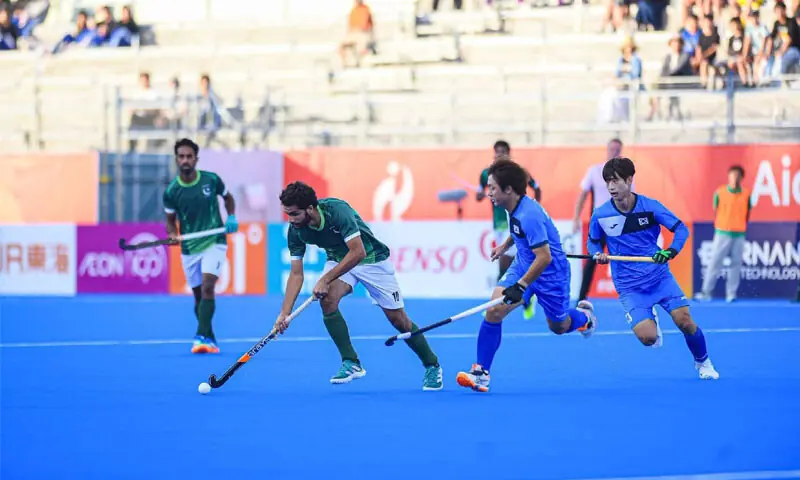
Pakistan’s hockey team secured the bronze medal at the 2026 Asian Games after defeating South Korea 5-3 in the third-place playoff. While the achievement ended the country’s wait for an Asian Games hockey medal following disappointing performances in the previous two editions, it also highlighted the challenges Pakistan must overcome to return to the top level of international hockey.
Pakistan has a proud history in the sport, having won eight Asian Games gold medals, compared with India’s five. Against that background, a bronze medal is a welcome development, but it falls short of the success expected from a team with such a distinguished record.
More importantly, winning the Asian Games would have secured direct qualification for the 2028 Los Angeles Olympics. Pakistan missed that opportunity and must now compete in the Olympic qualifying tournaments scheduled for early 2028.
With 16 teams expected to compete across two eight-team qualifying events for four or five Olympic places, the road ahead will be demanding. Pakistan have missed the last three Olympic Games, making qualification one of the national team’s most important objectives.
Pakistan’s Asian Games Campaign
Pakistan entered the tournament ranked third in Asia and 14th in the world. The team recorded convincing victories over Thailand, Uzbekistan, China and Oman during the pool stage.
However, Malaysia provided a much tougher challenge. Pakistan and Malaysia exchanged the lead several times in an entertaining contest, with Pakistan taking a 4-3 advantage in the closing minutes.
Despite creating several scoring opportunities and controlling much of the third and fourth quarters, Pakistan failed to secure the victory. Malaysia made better use of its chances and won 5-4.
The defeat sent Pakistan into a semi-final against India, the tournament favourites and winners of Pool B.
Pakistan had struggled against their traditional rivals for more than a decade, and India’s early 3-0 lead appeared to put the match beyond reach. However, Pakistan responded with an impressive attacking display.
Captain Abu Bakar Mahmood scored from a penalty corner just before half-time. In the 45th minute, Abdul Hannan Shahid finished a superb attacking move down the right flank to reduce the deficit further.
Rana Waheed then completed another excellent move from the right to bring Pakistan level at 3-3.
The contest became increasingly competitive, with both sides creating opportunities. Pakistan’s comeback ultimately ended in disappointment when India scored the winning goal in the final minute after a deflection sent the ball into the Pakistani net.
Pakistan showed similar determination in the bronze-medal match against South Korea. After falling behind 3-1, the team recovered to win 5-3 and claim the third-place medal.
Comebacks Highlight Pakistan’s Fighting Spirit
One of the most encouraging aspects of Pakistan’s recent performances has been the team’s ability to recover from substantial deficits.
The players demonstrated resilience during both the 2026 World Cup and the Asian Games, repeatedly turning difficult situations into competitive encounters.
However, the need for frequent comebacks also exposes a major weakness. Pakistan have conceded early goals in several matches, raising questions about defensive organisation, tactical preparation and game management.
The coaching staff must identify why the team repeatedly starts slowly and find ways to prevent opponents from establishing early leads.
Improving the opening stages of matches could make a significant difference to Pakistan’s results, particularly against stronger international opponents.
Sufyan Khan and Other Players Offer Encouragement
Despite the team’s inconsistent results, Pakistan continue to possess considerable individual talent.
Sufyan Khan emerged as one of the tournament’s leading scorers, finishing with 12 goals and sharing the top position in the Asian Games scoring charts. His drag-flicking ability has become an important weapon for Pakistan, particularly during penalty corners.
However, the semi-final against India exposed shortcomings in the team’s penalty-corner execution. Pakistan earned seven opportunities but converted only one.
The team had successfully used two-touch variations to score penalty-corner goals against Oman, but this option was not employed against India. A wider range of attacking routines and more consistent execution could help Pakistan become more effective in crucial matches.
Abdul Hannan Shahid and Rana Waheed have also established themselves as important attacking players. Goalkeeper Ali Raza produced encouraging performances, while captain Abu Bakar Mahmood continued to contribute in defence and through penalty corners.
Abu Bakar’s signing for Melbourne Cobras in Australia’s Hockey One competition further reflects his growing profile in international hockey.
Abdul Rahman also attracted attention at the 2026 FIH World Cup, winning the Poligrass Magic Skill Award for a goal against Wales that captured the imagination of hockey fans.
These individual achievements suggest that Pakistan still have players capable of competing at a high level. The challenge is to bring their abilities together in a consistent team performance.
Right-Wing Attacks Could Be Pakistan’s Greatest Strength
Historically, Pakistan’s most successful hockey teams have been particularly dangerous when attacking down the right wing.
The recent semi-final against India offered a reminder of how effective this approach can be. Both goals that brought Pakistan back into the contest originated from impressive attacking movements down the right flank.
The team should build on this strength by developing coordinated attacking patterns, improving movement off the ball and creating more opportunities for forwards in dangerous areas.
At the same time, Pakistan must address recurring defensive mistakes. Poor clearances and mistimed tackles have allowed opponents to win penalty corners and score avoidable goals.
Against elite teams, such errors can determine the outcome of an entire match. Better defensive discipline, communication and decision-making will therefore be essential to sustained improvement.
Pakistan Must Raise Their International Standards
