


Why French High School Students Are Protesting Across the Country
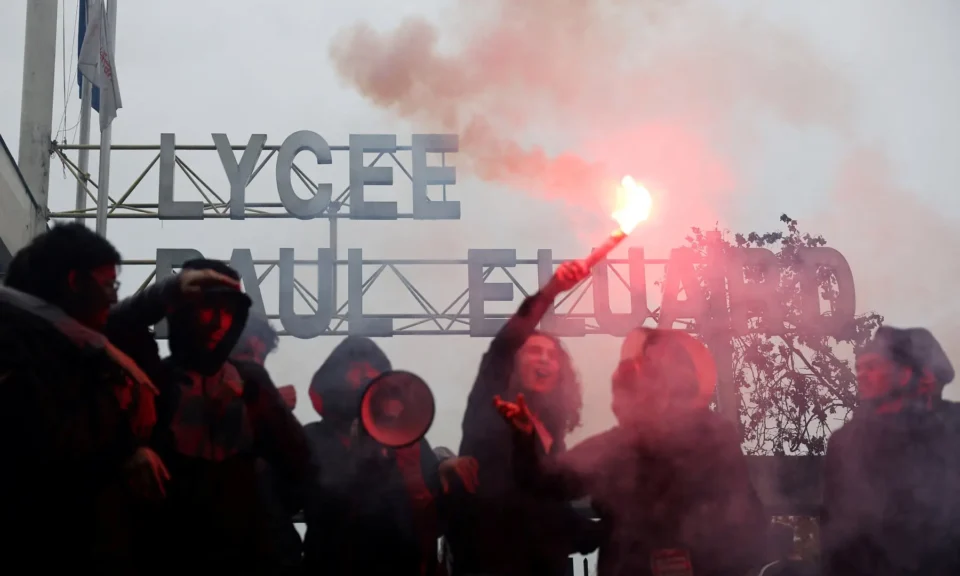
A growing wave of high school protests has spread across France, with students blocking school entrances and demanding improvements in education, staffing and classroom conditions.
The demonstrations have occasionally turned confrontational, with security forces using tear gas to disperse protesters. The government has acknowledged that some of the students’ concerns are legitimate but has condemned violence and accused the hard-left opposition of encouraging the movement.
Critics, meanwhile, have raised concerns over the use of force against protesters, many of whom are legally minors.
France’s Interior Ministry said more than 5,000 people had been arrested since Monday. The education minister also reported that around 735 educational institutions were affected by the protests on Friday. Another major day of demonstrations is expected on Tuesday.
Students Raise Concerns Over Education
The protests have mainly involved students at lycees, where French teenagers aged between 15 and 18 complete their secondary education.
Students have highlighted several problems, including teacher shortages, frequent staff absences, overcrowded classrooms, demanding timetables and long school days. Some students say their schedules can run from around 8am until 6pm.
Sociologist Valerie Becquet said students, particularly those living in lower-income areas, believe they are not receiving the same quality of education as students in more privileged communities.
How the Protests Started
The movement began on September 17 at Saint-Exupéry High School in the Paris suburb of Créteil. Students initially demonstrated in support of teachers who were protesting over staffing shortages and limited resources.
The campaign gradually expanded to schools in other parts of France during the following week.
Interestingly, the situation at Saint-Exupéry later improved after education authorities agreed to provide additional staff, including a deputy principal and a school nurse.
One student, Abderrahmane, said students were concerned about declining academic performance and felt that taking action was necessary to protect their future.
Social Media Accelerates the Movement
Social media platforms, particularly TikTok, have played an important role in spreading the protests.
Students have recorded demonstrations on their mobile phones, including scenes involving burning rubbish and police using tear gas. Videos showing the most dramatic incidents have subsequently been shared and edited across various online channels.
Becquet said social media allows young protesters to present their own version of events rather than relying entirely on traditional media coverage.
Concerns Over Inequality
Although France provides access to lycees for students across the country, major differences exist between educational institutions.
The system includes vocational schools as well as highly selective and prestigious institutions. Critics argue that students from wealthy and highly educated families remain disproportionately represented in elite schools despite efforts to improve diversity.
According to Becquet, significant inequalities continue to exist between students and schools, making equal access to quality education a major concern.
Political Dispute Grows
The protests have also become part of a wider political dispute, coming only months before France’s presidential election.
The government has accused the hard-left France Unbowed (LFI) party of helping drive the demonstrations. LFI official Manuel Bompard rejected the allegation and accused the government of promoting conspiracy theories.
Veteran LFI leader Jean-Luc Melenchon has voiced support for the students’ demands while urging protesters to avoid violence.
Tensions Between Protesters and Police
Some demonstrations have involved blocked school entrances, burning rubbish bins and objects being thrown at police. Authorities have responded by attempting to clear protest sites, with officers using tear gas and other crowd-control measures.
In some incidents, police have also been accused of using excessive force. Following clashes in Tours, prosecutors said a young man suffered an injury that resulted in the loss of sight in his right eye.
Videos circulating online have also prompted criticism of police conduct, including footage appearing to show an officer restraining a female student during an arrest.
Police officers have also faced attacks. In the eastern city of Belfort, an officer was reportedly chased, beaten and kicked by a group of young people linked to a school.
