


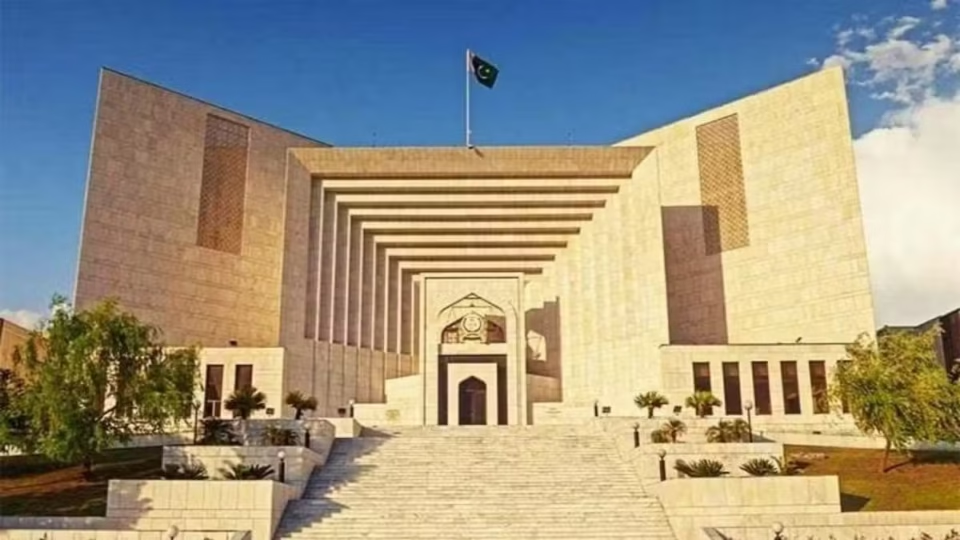
Supreme Court Directs Nikah Registrars to Complete All Nikahnama Details
ISLAMABAD: The Supreme Court has directed Nikah registrars to use the officially prescribed Nikahnama and ensure that all relevant sections are completed accurately and in accordance with the law.
A four-member bench led by Justice Shahid Waheed issued a 26-page judgment on Tuesday while deciding matters arising from orders of different benches of the Peshawar High Court and Lahore High Court.
The court observed that the case involved broader questions concerning the legal framework governing Muslim family matters, rather than simply the interpretation of an individual Nikahnama provision or the private rights of two spouses.
Directions on Haq Mahr
The judgment highlighted the legal importance of dower, commonly known as Haq Mahr, in a Muslim marriage. The court stated that where dower has not been paid, the courts have the authority to enforce the relevant legal rights.
The Supreme Court issued detailed instructions to ensure compliance with the Muslim Family Laws Ordinance, 1961, and related rules.
Under the directions, Nikah registrars must use the prescribed Nikahnama and properly complete all relevant columns. No section should be left blank or disregarded without a lawful reason.
The court particularly highlighted Columns 13 to 16, which relate to dower. Column 13 should clearly mention the total amount or value of the agreed dower, whether it consists of money, movable property or immovable property.
If property is included as dower, Column 16 should contain sufficient information to identify it, including its description, measurements, location and agreed value where applicable.
Registrars Must Explain Relevant Entries
The court directed registrars to read or explain relevant Nikahnama entries to the bride and groom before obtaining their signatures or thumb impressions.
This requirement is particularly important when the document contains details about dower, special conditions, delegated authority for divorce or property given as dower.
Any special condition entered in Column 17 must accurately represent the agreement between the parties and should not be based on wording independently created by the registrar.
The court further directed that registrars should not make entries based on assumptions or personal interpretations. Where any term is unclear, clarification must be obtained from the parties before the Nikahnama is completed.
Once the form has been completed, the registrar must authenticate and preserve the record, provide copies to both spouses and send the required copy to the relevant Union Council in accordance with the law.
Training and Monitoring Ordered
The Supreme Court also directed the relevant authorities, including chairmen and secretaries of Union Councils, to ensure that licensed Nikah registrars receive proper training on completing Nikahnamas.
Periodic training and orientation sessions should be conducted so that the document is completed carefully rather than as a routine formality.
Authorities were also instructed to conduct periodic inspections of registers maintained by Nikah registrars to check compliance with legal requirements and licence conditions.
The court said that appropriate action should be taken under the law if a registrar fails to perform statutory duties or violates the conditions of their licence.
