


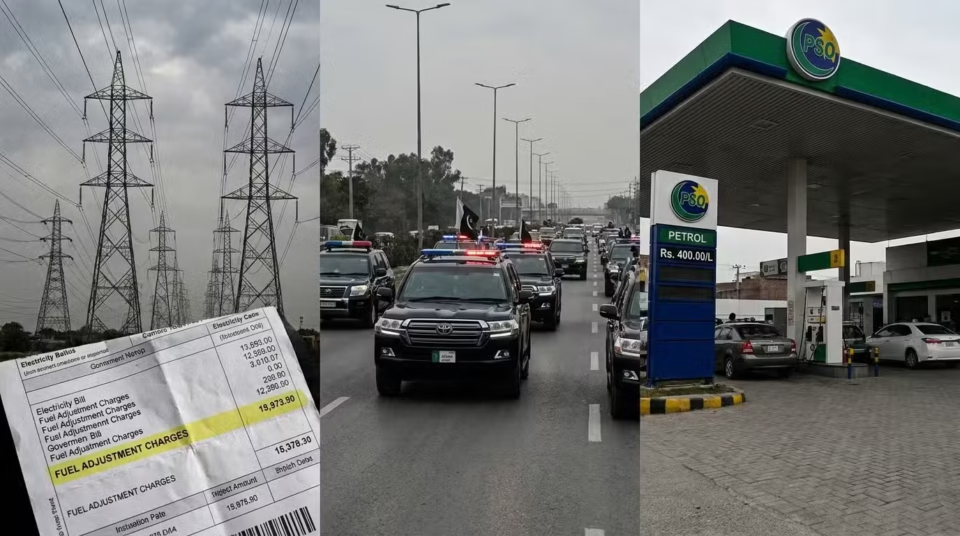
High Fuel and Electricity Costs Put Pressure on Pakistani Households
ISLAMABAD: Rising petrol and diesel prices are adding to the financial pressure already faced by households and businesses across Pakistan. With fuel prices approaching the Rs. 400 per litre mark, attention is increasingly turning toward other areas where the government could provide relief to consumers.
While international oil prices and global market conditions have contributed to higher domestic fuel costs, electricity bills remain another major expense for Pakistani households.
Fuel Prices Continue to Rise
Petrol and diesel prices have increased significantly during the recent period of daily fuel price revisions.
The government has maintained that international oil market conditions and geopolitical developments are major factors behind the increase. At the same time, petroleum products are subject to substantial government taxes and levies.
According to the figures cited in the original analysis, the petroleum levy is around Rs. 106 per litre on petrol and approximately Rs. 101 per litre on diesel.
Since global oil prices are largely outside the government’s direct control, the focus has shifted toward domestic taxes, government spending and other areas where policy decisions can potentially provide relief.
Electricity Bills Add to Household Burden
Electricity costs are another significant concern for consumers.
The final amount on an electricity bill is not always based solely on the basic electricity tariff. Depending on consumption and the type of connection, consumers may also see fuel price adjustments, quarterly tariff adjustments, financing-related charges, electricity duty, General Sales Tax (GST), income tax and fixed charges.
For households with higher electricity consumption, these additional components can significantly increase the total monthly bill.
This has prompted calls for the government to examine whether some electricity-related taxes and charges could be reduced without creating additional pressure on public finances.
Where Could Consumers Get Relief?
If maintaining petroleum revenue is necessary for meeting fiscal targets, policymakers could consider providing relief through other areas of household expenditure.
Possible measures could include reviewing electricity-related taxes and charges, improving the efficiency of the power sector and offering targeted support to households and businesses facing particularly high energy costs.
Any relief, however, would need to be carefully designed so that it does not create another major gap in the government’s finances.
Government Spending Also Under Scrutiny
Public spending is another area that could be reviewed as part of broader cost-cutting efforts.
Official travel, allowances, government vehicles, protocol-related expenses and other discretionary spending could be examined to identify areas where expenditure can be reduced without affecting essential government services.
The objective would not necessarily be to eliminate necessary official activities, but to ensure that public funds are being used efficiently at a time when households are facing higher living costs.
Balancing Revenue With Public Relief
Pakistan faces the difficult task of maintaining government revenue while protecting consumers from rapidly increasing living expenses.
The International Monetary Fund (IMF) programme also places importance on fiscal discipline and improving government finances. However, policymakers still have choices regarding how public resources are collected and spent.
A balanced approach could involve maintaining necessary fiscal measures while ensuring that households and businesses receive targeted relief where the economic burden is greatest.
Public Confidence Remains Important
Higher fuel and electricity costs affect transportation, food prices, business operations and household budgets. As a result, public confidence in economic policies depends not only on the measures themselves but also on how fairly the burden is distributed.
If consumers are expected to make sacrifices during periods of economic difficulty, greater transparency around government spending and efforts to control unnecessary expenditure could help strengthen public confidence.
Ultimately, Pakistan’s economic challenge is not simply about raising more revenue. It is also about ensuring that public money is spent efficiently while protecting ordinary consumers from excessive financial pressure.
A sustainable approach would require both fiscal responsibility and meaningful efforts to reduce the cost burden on households and businesses.
