


Pakistan, Saudi Arabia and Türkiye to Hold Emergency Defence Meeting in Riyadh
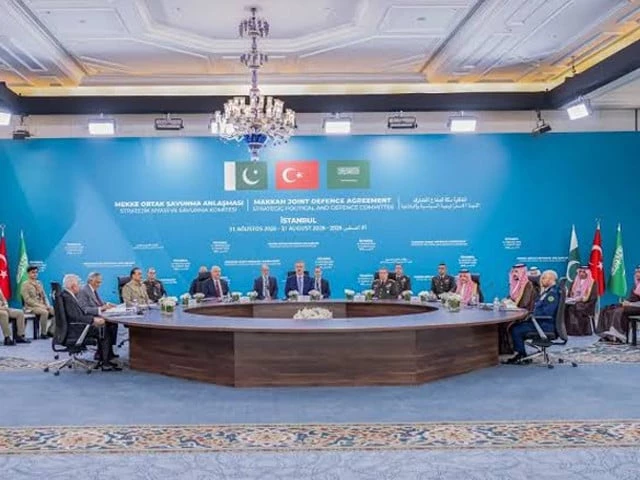
Pakistan, Saudi Arabia and Türkiye have agreed to hold an emergency meeting of the Strategic Political and Defence Committee (SPDC) of the Makkah Joint Defence Agreement in Riyadh next week.
The meeting will review the security situation in Saudi Arabia amid recent attacks attributed by Riyadh to Yemen’s Houthi movement, including an attack on a power facility in Madinah.
Deputy Prime Minister and Foreign Minister Ishaq Dar said the meeting would examine the latest developments and assess the situation on the ground, particularly attacks affecting civilian and economic infrastructure.
Defence Cooperation Under Review
The three countries signed the Makkah Joint Defence Agreement on August 7. Under the agreement, an armed attack against one member is to be treated as an attack against all three members.
The decision to convene the emergency meeting follows a meeting of the three foreign ministers on the sidelines of the United Nations General Assembly in New York on September 24.
Dar, Saudi Foreign Minister Prince Faisal bin Farhan and Turkish Foreign Minister Hakan Fidan discussed implementation of the agreement and agreed to increase coordination between their defence institutions.
Military chiefs from the three countries subsequently met in Riyadh on September 25. Their discussions included intelligence sharing, military coordination and closer integration of defence capabilities.
Pakistan has also condemned the reported attack on a power distribution facility in Madinah and reaffirmed its support for Saudi Arabia’s sovereignty and the security of the Two Holy Mosques. The Houthis have denied responsibility for the Madinah incident.
Iran Diplomacy Also Discussed
Dar said he had discussed the regional situation with Iranian Foreign Minister Abbas Araghchi. According to Dar, the Iranian side favoured political engagement with the Houthis and Iraqi armed groups rather than military action.
Dar said Pakistan had conveyed that it would honour its commitments under the defence agreement with Saudi Arabia.
The Iranian position does not currently represent a formal proposal, and Dar described the discussion as an exchange of views between the two foreign ministers. The possibility of political engagement is expected to be considered during discussions among the three member states.
Pakistan has continued to maintain diplomatic engagement with Iran while strengthening its security cooperation with Saudi Arabia and Türkiye.
Makkah Agreement Moves Toward Permanent Structure
The three countries are also working on establishing a permanent institutional framework for the defence agreement.
The first SPDC meeting was held in Istanbul on August 31 and included foreign and defence ministers as well as military chiefs from the three countries.
The meeting agreed to establish a permanent secretariat in Saudi Arabia, with a Pakistani secretary general initially serving for three years.
Retired Lieutenant General Nauman Mahmood was later appointed as the agreement’s first secretary general, with the secretariat planned for Riyadh.
The agreement also provides for cooperation in defence industries, technology development and joint production.
Dar said several countries had expressed interest in joining the arrangement. However, he indicated that membership would be considered after the secretariat and other institutional mechanisms become fully operational.
He also described the agreement as defensive in nature and said any decision regarding new members would be taken jointly by Pakistan, Saudi Arabia and Türkiye.
Pakistan Highlights Regional Diplomacy
During his briefing, Dar also discussed Pakistan’s diplomatic efforts on several regional issues, including the Middle East, Iran and the Gulf region.
He said Pakistan continued to support dialogue and de-escalation, arguing that military conflict was not a long-term solution to regional disputes.
Dar also referred to Pakistan’s diplomatic engagement in discussions involving the United States and Iran, as well as efforts related to energy supplies and shipping routes affected by regional tensions.
The foreign minister further discussed Pakistan’s position on Kashmir and the Indus Waters Treaty, reiterating Islamabad’s longstanding stance on both issues.
He said Pakistan had also participated in several international and regional meetings focused on Gaza, Afghanistan, Jammu and Kashmir and other security matters.
