


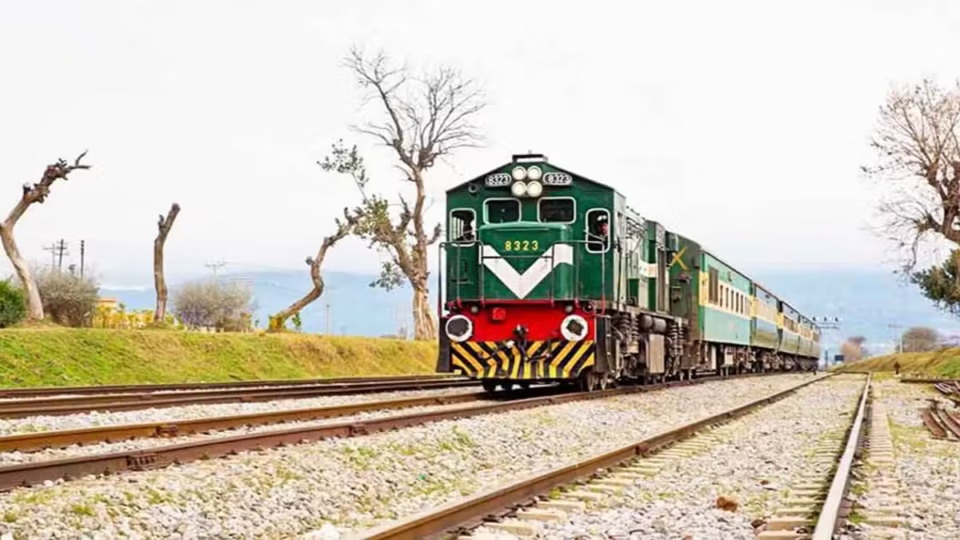
ML-1 Upgrade Expected to Cut Karachi-Peshawar Travel Time to 25–30 Hours
Pakistan’s planned Main Line-1 (ML-1) railway modernization is expected to significantly reduce travel time between Karachi and Peshawar, with the journey potentially falling from the current 70–90 hours to around 25–30 hours.
The project is being supported by the Special Investment Facilitation Council (SIFC) and is aimed at improving connectivity, strengthening logistics and making the movement of passengers and freight more efficient across the country.
Faster and More Efficient Rail Network
The ML-1 upgrade will focus on improving railway infrastructure and increasing the capacity of the main rail corridor. The project is also expected to support a dedicated freight corridor, enabling more goods to be transported by rail and helping reduce congestion on Pakistan’s road network.
The Karachi-Peshawar route is one of the country’s most important railway corridors, linking major cities, industrial areas and ports. Official Pakistan Railways material describes ML-1 as a key connection between Karachi and Peshawar.
Improved Freight Transportation
A modernized ML-1 could make rail freight faster and more reliable, particularly for businesses transporting large volumes of goods.
Better rail capacity would also help connect major commercial and industrial centers with Pakistan’s ports, potentially lowering transportation costs and improving the efficiency of supply chains.
Benefits for Other Railway Routes
The project is also expected to improve the commercial potential of ML-2 and ML-3 by strengthening freight links with areas such as Attock, Quetta, Taftan and mineral-producing regions.
Improved connectivity could make it easier for industrial and mineral products to reach markets, supporting trade and wider economic activity.
A Major Step for Pakistan’s Transport System
The modernization of ML-1 is being viewed as an important part of Pakistan’s efforts to develop a faster and more integrated transportation network.
Recent government efforts have focused on advancing the project in phases, with work on the Karachi-Rohri section being considered as an initial stage.
If implemented as planned, the upgraded railway could improve passenger travel, increase freight capacity and strengthen connections between Pakistan’s major economic centers.
