


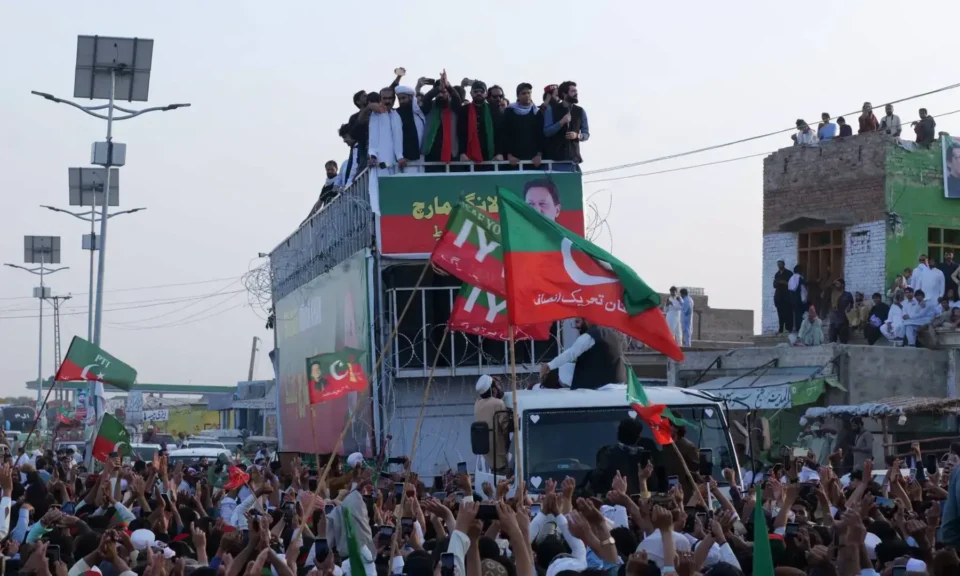
JUI-F chief urges government to allow PTI long march
Jamiat Ulema-i-Islam-Fazl (JUI-F) chief Maulana Fazlur Rahman has urged the government not to block the Pakistan Tehreek-e-Insaf (PTI) long march towards Islamabad, saying peaceful protests are part of the democratic process.
Speaking to journalists alongside opposition leaders outside his residence on Tuesday, Maulana Fazl said the government should trust the PTI’s stated intention to hold a peaceful protest. He also called for political parties to resolve differences through dialogue.
A delegation of opposition leaders, including Senate opposition leader Allama Raja Nasir Abbas, former National Assembly speaker Asad Qaiser, Akhundzada Hussain and PTI Secretary General Salman Akram Raja, met Maulana Fazl. The JUI-F delegation included Senator Kamran Murtaza and other party leaders.
Maulana Fazl said talks between the government and opposition could have made progress if, according to him, outside or behind-the-scenes involvement had not affected the process. He said successful negotiations require both sides to show flexibility and be willing to make compromises.
The JUI-F chief said political and democratic forces should favour dialogue. He added that opposition parties had already held consultations in parliament, while differences between the government and opposition remained evident.
Responding to concerns over political loyalty, Maulana Fazl said all Pakistanis should be regarded as patriotic and committed to the Constitution and the state. He stressed the need for balance in the country’s political environment.
He also confirmed that opposition parties had invited him to participate in a multi-party conference. Maulana Fazl said his party would discuss the invitation before deciding its participation and suggested that consultations should lead to a joint agenda.
The JUI-F chief also criticised the prospect of another anti-terrorism operation in Khyber-Pakhtunkhwa. He said previous operations in areas including Swat and Waziristan had not fully restored normal life for residents who were unable to return to their homes.
According to Maulana Fazl, law and order problems have also affected the functioning of the provincial government in Khyber-Pakhtunkhwa. He questioned how long military operations could continue as the primary response to terrorism.
Senator Allama Raja Nasir Abbas said the opposition delegation had visited Maulana Fazl after his return from Umrah to congratulate him and invite him to the proposed conference.
He said opposition parties wanted to develop a consensus-based agenda through consultation, arguing that a jointly prepared plan could address issues affecting the country as a whole.
Raja Nasir Abbas also said political instability could create space for extremist tendencies and noted that Maulana Fazl had opposed proposals for imposing governor’s rule or an emergency in Khyber-Pakhtunkhwa.
