


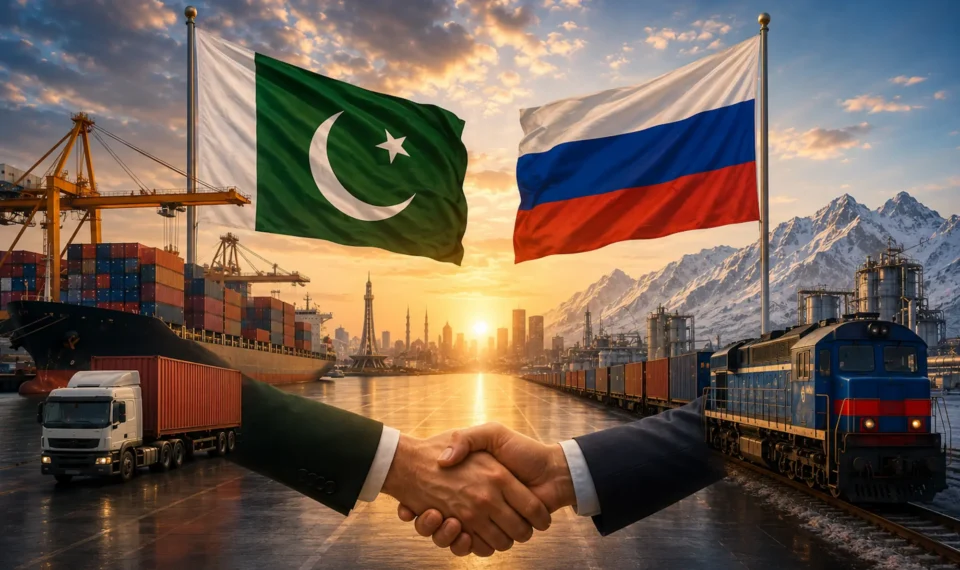
Pakistan-Russia Relations: Experts Outline Roadmap for Stronger Trade, Energy and Education Cooperation
As global geopolitical and economic dynamics continue to evolve, experts are encouraging Pakistan and Russia to strengthen bilateral cooperation through practical initiatives focused on trade, energy, education and regional connectivity.
The recommendations emerged during a high-level webinar titled “Pakistan-Russia: Strengthening Trade, Energy & Education Collaboration,” jointly organized by the Institute of Regional Studies (IRS), Islamabad, and the University of World Civilizations, Moscow.
The event brought together diplomats, policymakers, academics and business leaders from both countries to discuss ways of expanding long-term cooperation through sustainable economic and institutional partnerships.
Focus on Practical Cooperation
Participants emphasized that Pakistan and Russia should move beyond symbolic agreements and prioritize practical projects that promote trade, investment, technology transfer and regional connectivity.
According to the discussion, stronger institutional coordination and long-term planning will be essential to transforming political goodwill into measurable economic outcomes.
Key Recommendations
Strengthening Institutional Cooperation
Experts recommended creating sector-specific working groups under a Pakistan-Russia Intergovernmental Commission to oversee progress in areas including:
- Trade and investment
- Energy
- Agriculture
- Education
- Digital economy
- Transport and logistics
They also proposed developing a long-term economic roadmap covering five to ten years to guide bilateral cooperation.
Expanding Trade and Investment
Participants suggested several measures to facilitate business activity between the two countries, including:
- Improving customs and certification procedures
- Exploring alternative payment mechanisms
- Enhancing trade financing options
- Encouraging private-sector investment
- Expanding market access through regional economic cooperation
These steps could help reduce barriers for businesses and support long-term commercial partnerships.
Improving Regional Connectivity
Infrastructure development was highlighted as another priority.
Experts proposed:
- Studying new transport and trade corridors
- Expanding railway connectivity
- Modernizing logistics facilities
- Improving cargo handling and customs digitization
- Utilizing Pakistan’s ports to strengthen regional trade links
Better transport networks could support increased trade between Pakistan, Central Asia and other regional markets.
Energy and Agricultural Collaboration
The webinar also identified opportunities for cooperation in several sectors, including:
- Oil and gas
- LNG
- Renewable energy
- Power infrastructure
- Agricultural technology
- Food processing
- Fertilizers and irrigation systems
Joint ventures in industrial manufacturing and engineering were also encouraged.
Education and Human Resource Development
Participants recommended expanding educational cooperation through:
- Student exchange programs
- Scholarships
- Joint research initiatives
- Dual-degree programs
- Language training
- Academic partnerships between universities
Strengthening people-to-people connections was viewed as an important element of long-term bilateral relations.
Digital Economy and Technology
The discussion also highlighted opportunities for collaboration in emerging technologies, including:
- Artificial intelligence
- Cybersecurity
- Digital public services
- Information technology
- E-governance solutions
Experts said technology partnerships could support innovation and economic development in both countries.
Looking Ahead
Participants agreed that sustained progress will depend on regular institutional dialogue, clear implementation plans and continued cooperation between governments, businesses and academic institutions.
They concluded that expanding collaboration in trade, education, energy and connectivity could contribute to stronger bilateral relations while creating new economic opportunities for both Pakistan and Russia.
