


Researchers Develop Solar Cells Designed to Generate Electricity Underwater
Researchers at Yunnan University have developed a new type of perovskite solar cell designed to generate electricity in underwater environments.
The research team, led by Simin Ma, believes the technology could eventually provide a renewable power source for marine sensors, underwater Internet of Things (IoT) devices and autonomous underwater equipment.
Solar Cells Optimized for Underwater Light
Unlike traditional silicon solar panels, perovskite solar cells can be engineered to absorb specific wavelengths of light.
This feature is particularly useful underwater because water absorbs and filters out many wavelengths that conventional silicon solar cells use to generate electricity.
The researchers designed their cells to make better use of the light that remains available at depths of around 10 meters.
Under laboratory lighting designed to simulate underwater conditions, the cells achieved an energy conversion efficiency of approximately 35%.
For comparison, conventional silicon solar panels generally achieve efficiencies of around 20% under standard testing conditions. However, the two efficiency figures were measured under different lighting environments.
Improving Resistance to Water
One of the major challenges with perovskite technology is its sensitivity to moisture. Exposure to water can cause the material to deteriorate and reduce its performance.
To address this issue, the researchers used an additive known as polyhexamethylene guanidine hydrochloride.
The material helps create a water-resistant layer while also improving the structure of the perovskite crystals. It promotes the formation of larger crystals and limits the movement of ions within the material, helping improve stability and electrical performance.
The completed solar cells were additionally sealed between protective layers before being tested underwater.
Cells Retain 99.6% Efficiency After 40 Days
In laboratory experiments, the solar cells were submerged in seawater for approximately 40 days while being exposed to filtered light designed to replicate underwater conditions.
After the test period, the cells retained 99.6% of their initial efficiency.
Based on the observed degradation rate, the researchers estimated that the cells could potentially remain in seawater for around 5.5 years before their performance falls to 80% of the original level.
Although this projected lifespan is considerably shorter than that of conventional silicon solar panels, the results represent a notable improvement in the durability of perovskite cells for underwater applications.
Real-World Test in the South China Sea
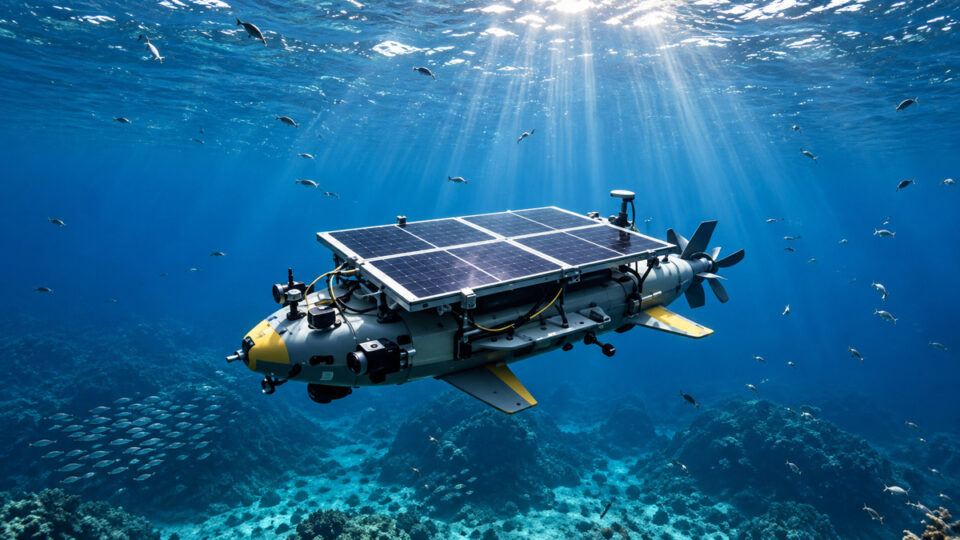
The researchers also conducted a field test in the South China Sea by mounting a solar panel on a small underwater vehicle.
The system successfully generated enough electricity to charge coin-cell batteries for several hours at depths of 2, 6 and 10 meters.
At a depth of two meters, power production varied as waves changed the amount and angle of sunlight reaching the panel.
At greater depths, the available light was weaker but more stable because of increased scattering. At 10 meters, the panel produced slightly less than one-quarter of the energy generated at two meters.
Potential Applications for Marine Technology
The research team believes the technology could eventually be used to provide power for underwater sensors, marine IoT devices, autonomous systems and unmanned underwater vehicles.
However, the technology has practical limits. At significantly greater depths, sunlight becomes too weak for solar power generation to remain an efficient energy source.
Further research and longer-term field testing will be needed to determine how effectively these underwater solar cells can operate in different marine environments.
