


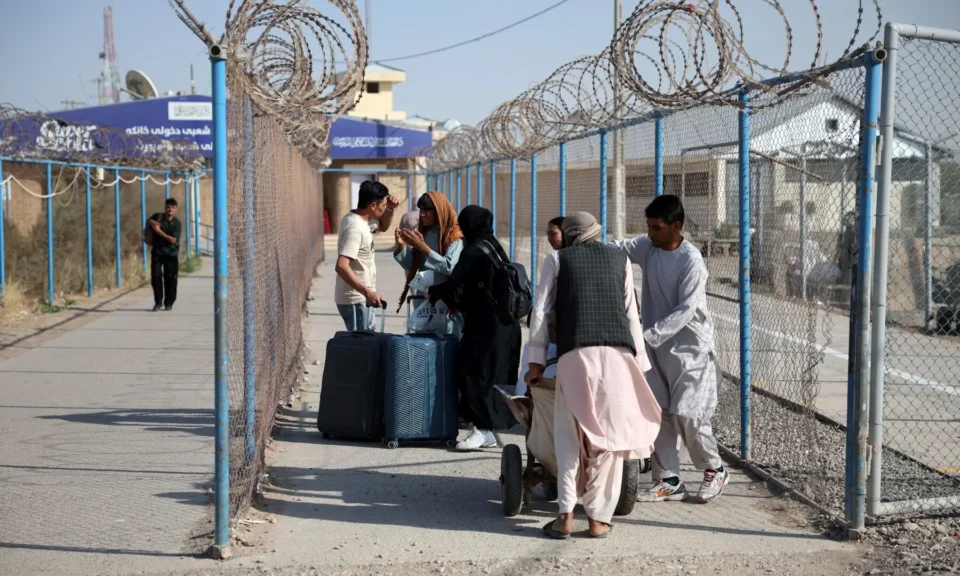
Afghan Families Return From Iran as Economic Crisis Deepens
Thousands of Afghans who had built their lives in Iran are returning to Afghanistan as the country’s worsening economic conditions make it increasingly difficult for migrants to earn a living.
Among those returning are entire families who had previously remained in Iran to avoid poverty and the restrictions imposed under Taliban rule in Afghanistan. The deteriorating economic situation in Iran has forced many to reconsider that decision despite the challenges they may face after returning home.
Economic Crisis Pushes Afghan Migrants Back
Mohammad Saeed, who moved to Iran with his family after the Taliban returned to power in Afghanistan in 2021, is among those who have recently gone back.
Saeed said his family’s savings lost more than two-thirds of their value after the Iranian currency weakened sharply. Like many other Afghan migrants, the family returned with very few financial resources.
For decades, Iran’s larger economy had provided employment opportunities for Afghan migrants. However, rising inflation, declining consumer demand and fewer jobs have made it increasingly difficult for many to support themselves.
Returnees interviewed in western Afghanistan said they had often been without work for months before deciding to leave Iran.
Inflation Makes Daily Life More Difficult
Iran’s economic problems have significantly increased the cost of basic goods.
According to Iran’s Statistical Centre, consumer prices had risen by nearly 90 percent year-on-year, while food inflation was close to 130 percent.
The economic pressure has also affected Afghan migrants working in local markets. Sayed Jawed Qazi Khani, a 40-year-old Afghan migrant, said business opportunities had declined sharply as both Iranian consumers and Afghan workers saw their savings disappear.
He said many migrants were left relying on daily wage work, with earnings often remaining close to previous levels despite the rising cost of living.
An International Organization for Migration (IOM) survey found that only 29 percent of Afghans who recently returned from Iran still had savings. The survey also indicated that their average income had dropped by almost one-third compared with pre-crisis levels.
More Afghan Families Are Returning
More than two million Afghans have left Iran during the past two years, with deportations and pressure from Iranian authorities accounting for a significant portion of the departures, according to United Nations refugee data.
However, return patterns have changed as the economic crisis has intensified.
While unaccompanied Afghan men have historically made up a large share of those returning, recent arrivals increasingly include women and complete families, according to returnees and IOM data.
At the Islam Qala border crossing in Afghanistan’s Herat province, officials have reported a steady movement of Afghan migrants returning from Iran.
Abdul Ghani Qazizadeh, a senior Taliban government official at the border, said around 20 to 40 families, including women and children, were voluntarily returning each day.
He said some workers had complained that their Iranian employers had not paid them their full wages.
Families Face Difficult Conditions After Return
For many returnees, going back to Afghanistan has brought new economic and social challenges.
Abdul Jabbar, 44, had lived in Iran for nearly four decades with his family. He worked as an exterior building finisher and said his family had enjoyed a relatively comfortable life before returning.
The family eventually left Iran after the conflict disrupted work and the area where they lived came under attack.
After arriving in Afghanistan, Jabbar found himself unemployed and dependent on relatives for basic necessities. His family now lives in a one-room mud-brick home, with solar panels providing their only source of electricity.
His 15-year-old daughter, Setayesh, said she misses her friends and education in Iran and would return if she had the opportunity.
Afghan Family Restarts Cheese Business
Not every returning family has abandoned its plans for rebuilding a livelihood.
Saeed and his mother, Rezwana Jami, established a cheese-making business in Iran after arriving there in 2021. Their business initially attracted regular customers and focused on producing cheese used for pizzas.
As inflation and shortages made it increasingly difficult to obtain ingredients, including milk, the family eventually stopped production and returned to Afghanistan.
After arriving in Herat, Jami and her son used their remaining savings to purchase kitchen equipment and restart their cheese business.
They believe there is an opportunity in Afghanistan because quality pizza cheese remains relatively difficult to find in the local market.
Girls Face Education Challenges After Returning
The return has also created concerns for Afghan girls who had access to education while living in Iran.
Jami said her 17-year-old daughter has struggled with the change after returning to Afghanistan. She had completed eight years of education but is now unable to continue her studies under the restrictions currently imposed on girls and women.
The family is trying to rebuild its income through the cheese business while adjusting to life back in Afghanistan.
For many Afghan migrants, the decision to return from Iran reflects a difficult balance between worsening economic conditions abroad and the social, educational and employment restrictions they may encounter after returning home.


