


Scientists Detect New Clues About Black Hole Event Horizons Through Gravitational Waves
Scientists have reported a significant breakthrough in the study of black holes, identifying what they describe as the first detectable signs linked to a black hole’s event horizon using gravitational wave data.
The findings, published in the scientific journal Nature, are based on the analysis of gravitational waves generated by the collision of two black holes. Researchers say the study offers a new way to investigate some of the most extreme environments in the universe.
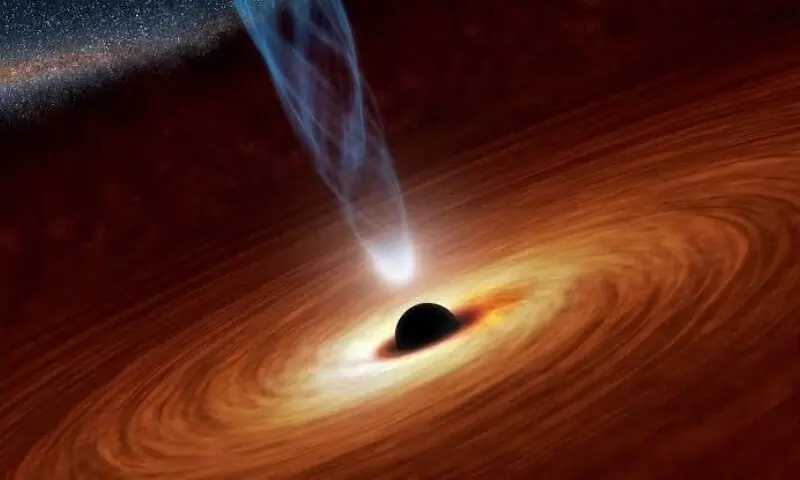
An event horizon is the boundary surrounding a black hole beyond which nothing, including light, can escape. Because these regions cannot be observed directly, scientists have long searched for alternative methods to study their properties.
The research team examined data from one of the strongest gravitational wave signals ever recorded, known as GW250114, which was detected in early 2025. By analyzing the final stage of the black hole merger, scientists were able to gather information from a region closer to the event horizon than previously possible.
Researchers believe the observations provide additional support for key predictions of Albert Einstein’s theory of general relativity. The study also revealed evidence of a phenomenon known as “frame dragging,” where a rotating black hole influences the surrounding fabric of space-time.
Scientists say the discovery could help improve our understanding of how black holes behave and how gravity operates under extreme conditions.
While experts have welcomed the findings, they also note that further research and independent verification will be important to confirm the results and explore their implications.
The breakthrough highlights the growing importance of gravitational wave astronomy, a field that has transformed scientists’ ability to study cosmic events that were once impossible to observe.
Researchers hope that future observations will provide even deeper insights into black holes and may eventually help answer some of the biggest questions about the nature of space, time and the universe itself.
