


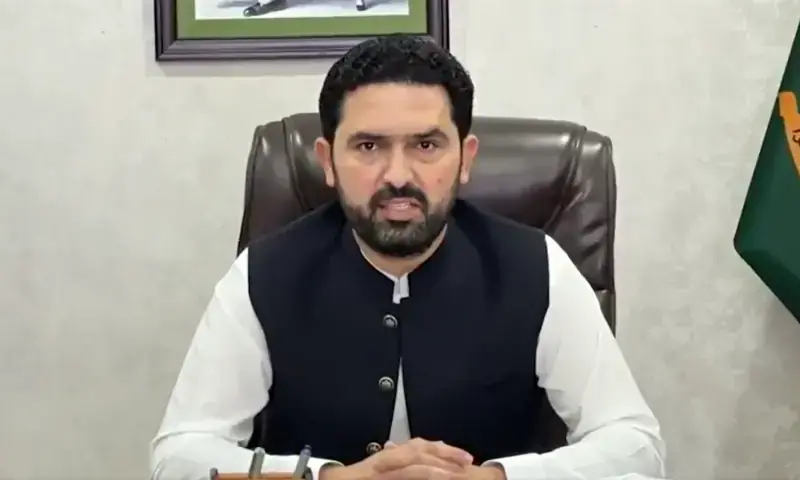
Sohail Afridi faces challenge of balancing political agitation and governance in KP
PESHAWAR: Khyber Pakhtunkhwa remains a key political base for Pakistan Tehreek-e-Insaf (PTI), but the provincial government is facing growing pressure to balance its political activities with the responsibilities of governing a province dealing with serious security challenges.
PTI is continuing its political campaign for the release of party founder Imran Khan, while Khyber Pakhtunkhwa has experienced a persistent security crisis, with militant attacks putting pressure on both the provincial administration and security institutions.
The province has remained an important political stronghold for PTI since the party formed the government there. However, critics have questioned whether the administration is giving sufficient attention to law and order, governance and other provincial matters while participating in political mobilisation.
According to the Centre for Research and Security Studies’ Annual Security Report 2025, Pakistan recorded 3,417 fatalities linked to violence in 2025, compared with 2,555 in 2024. Khyber Pakhtunkhwa accounted for 711 of the deaths recorded during the year.
Federal officials have repeatedly criticised the KP government over the security situation and alleged that coordination between the provincial and federal administrations has remained inadequate.
Chief Minister Sohail Afridi, meanwhile, has criticised military operations against militant groups in the province and advocated greater emphasis on dialogue and diplomatic engagement with Afghanistan.
Afridi has argued that the worsening security situation is linked to policies pursued over the past two decades and has called for a review of approaches that have not produced the desired results.
Afridi’s political role
Alongside his responsibilities as chief minister, Afridi has emerged as one of PTI’s prominent figures in its ongoing political campaign.
He has travelled to Islamabad to meet Imran Khan and has played an active role in coordinating the party’s protest activities. His political background in the Insaf Students Federation has also helped him maintain a strong connection with PTI’s younger supporters.
Political observers say Afridi’s position within the party reflects PTI’s broader strategy of maintaining political pressure on the federal government.
Professor Faizullah Jan of the University of Peshawar said Afridi’s relatively young age and political background had helped him emerge as an outspoken representative of the party’s position.
However, his growing involvement in political mobilisation has also raised questions about how effectively the provincial administration can focus on governance at a time when the security situation remains challenging.
Pressure for better governance
Analysts believe the biggest challenge for Afridi is to maintain political activity while ensuring that the provincial government continues to function effectively.
Ahmed Bilal Mehboob of the Pakistan Institute of Legislative Development and Transparency (Pildat) said both the federal and provincial governments needed to maintain a working relationship.
He also warned that imposing governor’s rule could increase political tensions rather than resolve them, arguing that cooperation between the two sides remained important.
KP Governor Faisal Karim Kundi, however, has criticised the provincial government for what he describes as excessive focus on political agitation.
Kundi has accused the administration of failing to give sufficient attention to terrorism, corruption, health services, universities and other provincial matters.
The governor has also supported governor’s rule as a constitutional option, but acknowledged that such a step should only be considered if the situation deteriorates significantly.
Security remains the biggest concern
The continuing threat from militant groups has added another layer to the political dispute between the federal and KP governments.
Security analysts say disagreements between the two administrations could make counterterrorism efforts more difficult and potentially create opportunities for militant groups to exploit political divisions.
Riccardo Valle, a research analyst focusing on militancy in South and Central Asia, said poor governance, local grievances and gaps in state services could affect the wider security environment.
He also noted that counterterrorism could not be treated as the responsibility of one provincial government alone and required coordination between different levels of government.
According to Valle, previous military operations in the province produced significant security gains but also resulted in displacement and social and economic challenges. He said the changing tactics of militant groups had made the security situation more complicated.
For Afridi, the challenge is therefore twofold: maintaining PTI’s political momentum while demonstrating that his administration can address security, governance and public-service issues in Khyber Pakhtunkhwa.
The ability to maintain cooperation with the federal government while managing PTI’s political campaign could prove crucial for the future of his administration.
