


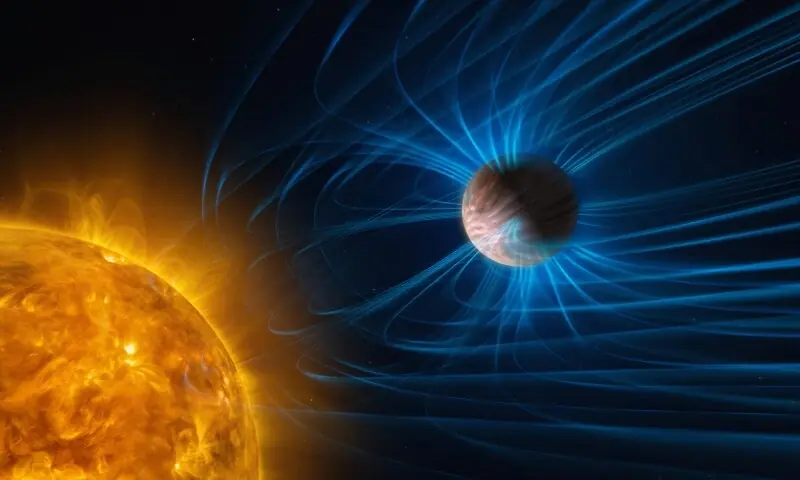
Astronomers have found the strongest evidence so far that planets outside our solar system may also have magnetic fields, similar to Earth and several planets in our own solar system.
The discovery is based on observations of seven large, hot gas giant exoplanets using telescopes in Chile and Hawaii. Researchers say the findings suggest that magnetic fields may be a common feature among many planets beyond the solar system.
What scientists discovered
Magnetic fields are invisible forces generated by the movement of electrically conducting material inside a planet, usually linked to a molten core and planetary rotation. These fields can influence a planet’s atmosphere and long-term evolution.
The studied exoplanets, often called “hot Jupiters,” are gas giants similar in size to Jupiter but orbit extremely close to their host stars. As a result, one side of each planet is permanently exposed to intense heat while the other remains in darkness.
Unexpected atmospheric behaviour
Researchers observed extremely fast winds on these planets, reaching speeds of up to 25,000 kilometres per hour. Interestingly, the hottest planets showed weaker atmospheric mixing than expected.
Scientists believe this unusual pattern may be explained by magnetic fields interacting with charged particles in the atmosphere, slowing down wind circulation.
Why this matters
Although these exoplanets are not considered suitable for life, the findings help scientists better understand how planetary magnetic fields form and behave. On Earth, the magnetic field plays an important role in protecting the atmosphere and supporting conditions suitable for life.
Experts say that studying distant planets can also provide clues about how rocky, potentially habitable worlds might evolve over time.
Researchers describe the discovery as an important step forward in understanding the diversity and structure of planets across the universe.
