


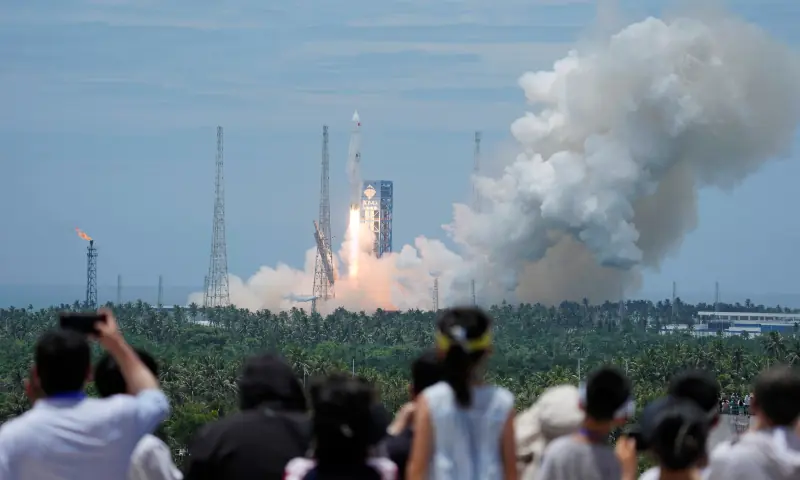
China Successfully Tests Sea-Based Rocket Booster Recovery System
China has successfully completed a major test of a new sea-based rocket recovery system, marking an important step in its efforts to develop reusable space launch technology.
According to Chinese state media, the Long March 10B rocket lifted off from the Hainan Commercial Space Launch Site on Friday. After completing its mission and separating from the upper stage, the rocket’s booster returned vertically and was successfully recovered on an offshore platform using a specially designed net system.
The mission also successfully placed a satellite into its planned orbit before the booster recovery took place.
First Successful Recovery of an Orbital-Class Booster
The successful test represents China’s first recovery of an orbital-class rocket booster, bringing the country’s space program closer to operating reusable launch vehicles. Reusable rockets are designed to reduce launch costs by allowing key components to be used for multiple missions.
Following the announcement, shares of several Chinese aerospace companies recorded gains in the local stock market.
How the Recovery System Works
Unlike conventional recovery methods, the Long March 10B uses four landing hooks that allow the returning booster to be captured by a large net mounted on an offshore platform.
Engineers say the net-based system reduces the need for heavy landing equipment on the rocket itself, helping lower overall weight while increasing payload capacity. The design is also intended to improve recovery success by allowing greater flexibility in landing accuracy.
Long March 10B Capabilities
Developed by the China Academy of Launch Vehicle Technology (CALT), the Long March 10B is a medium-lift launch vehicle designed for commercial space missions. It can carry at least 16 metric tons of payload into low-Earth orbit.
The rocket has often been compared with other reusable launch systems because of its focus on recovering and reusing the booster stage.
Expanding China’s Reusable Rocket Program
China has spent several years developing reusable launch technology through a series of ground tests and experimental flights. The country aims to lower the cost of future satellite launches and support its expanding commercial space industry.
Both state-owned and private aerospace companies are working on reusable rocket systems, although previous recovery attempts by Chinese developers were unsuccessful during the final landing phase.
Support for Future Lunar Missions
The Long March 10 family of rockets is also expected to play an important role in China’s planned crewed lunar missions before 2030. Data collected during the latest recovery test is expected to support the development of future launch systems for those missions.
Chinese state media reported that the recovered Long March 10B booster is expected to be prepared for another launch before the end of the year, demonstrating the country’s continued progress toward reusable space transportation.
