


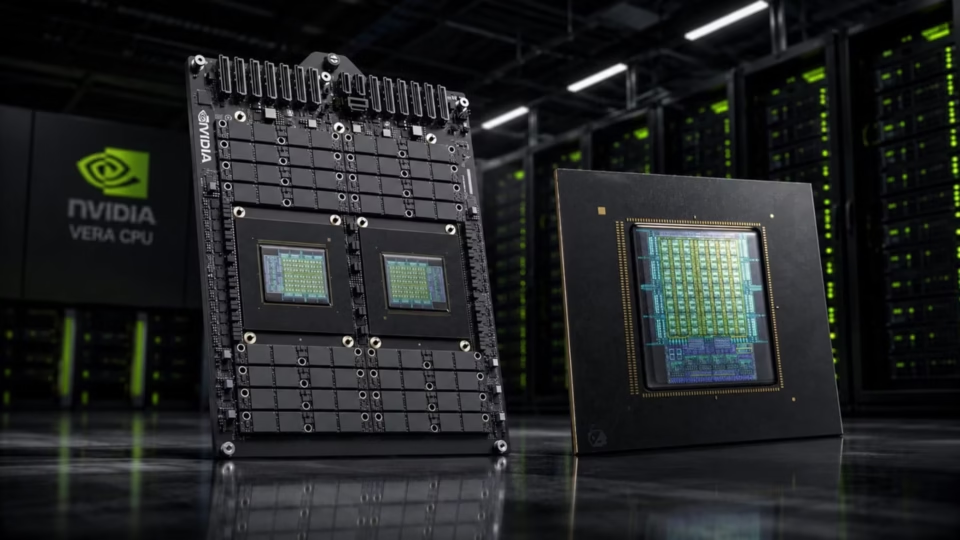
Nvidia Says Vera CPU Targets AI Era With Major Performance Gains Over x86 Chips
Nvidia has introduced details of its new Vera CPU, a data center processor designed for agentic AI workloads, claiming it delivers significant performance improvements over traditional x86-based CPUs.
According to reports, Nvidia says Vera achieves the highest instructions per clock (IPC) among modern CPUs and can deliver up to 80% better performance compared to x86 processors in certain workloads.
Designed for Agentic AI Workloads
Vera is built for “agentic AI” systems—advanced AI models that can execute code, use tools, retrieve data, and perform multi-step tasks with minimal latency. Nvidia says these workloads are increasingly moving beyond traditional CPU tasks and require faster, more responsive processing.
The CPU is designed to support real-time execution environments where AI agents can run programs such as Python or Java, manage workflows, and process data securely in isolated environments.
Key Specifications
Vera features 88 custom-designed Olympus cores, supporting a total of 176 threads. Each core is optimized for low-latency and control-heavy AI tasks.
The processor also includes a large cache structure, with 2MB L2 cache per core and a shared 164MB L3 cache. Power consumption is reported to range between 250W and 450W depending on configuration.
Unlike many modern server chips that use chiplet-based designs, Vera uses a single-die architecture to reduce internal latency and improve data flow between cores.
Memory and Bandwidth Improvements
Nvidia has equipped Vera with LPDDR5X memory support, offering up to 1.5TB of memory capacity and around 1.2TB/s of memory bandwidth.
The chip also features a high-bandwidth interconnect system designed to improve data movement between cores, with significantly higher internal bandwidth compared to conventional server CPUs.
Performance Claims
Nvidia reports that Vera delivers strong performance gains across AI-related workloads such as code compilation, Python execution, database processing, and data streaming tasks.
In benchmark comparisons, the CPU is said to outperform previous-generation systems in latency-sensitive environments, including large-scale real-time data processing scenarios.
Deployment and Industry Use
Vera is expected to power Nvidia’s next-generation AI infrastructure platforms, including rack-scale systems designed for large-scale AI model deployment.
The company says early versions of Vera systems are already being evaluated by major cloud providers and AI-focused organizations. Server manufacturers are also expected to integrate the CPU into future enterprise hardware offerings.
Focus on AI Infrastructure
Nvidia positions Vera as a foundational processor for the next phase of AI computing, where systems rely heavily on autonomous agents that require fast execution, high memory bandwidth, and efficient orchestration across large-scale data centers.
The company believes this shift will make CPUs more central to AI workflows than in traditional computing models, especially in environments handling continuous real-time AI operations.
