


Asian Games Conclude in Japan After Record Performances and Organisational Challenges
Sports Correspondent: Imran Sohail
NAGOYA: The Asian Games in Japan are set to conclude after two weeks of impressive sporting performances, record-breaking achievements and several organisational difficulties.
More than 17,000 athletes and officials took part in the event held across Nagoya and Aichi prefecture, making it one of the largest multi-sport competitions in Asia.
China dominated the medal standings with 169 gold medals, while hosts Japan finished second with 83 golds.
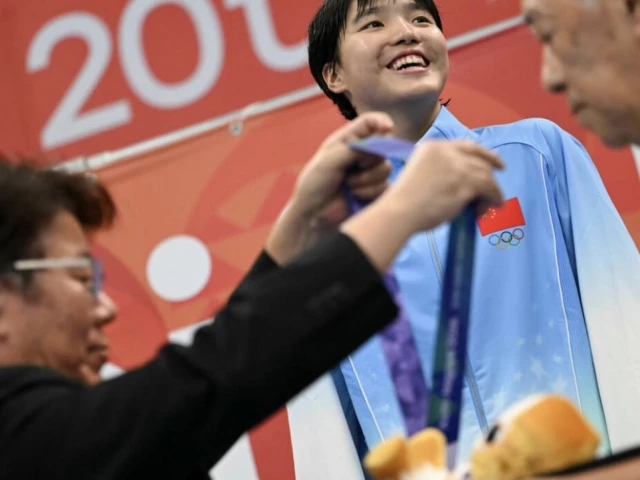
One of the biggest highlights of the Games was Chinese swimmer Yu Zidi. The 13-year-old won three gold medals, with all three victories coming in Games-record times.
Yu claimed gold in the 200-metre butterfly and also won the 200m and 400m individual medley events. Her performances have increased expectations about her future prospects, including at the 2028 Los Angeles Olympics.
Japan also celebrated a major swimming achievement as 17-year-old Shin Ohashi set a new world record in the men’s 200m breaststroke.
In athletics, Thailand’s Puripol Boonson won both the men’s 100m and 200m titles. The 20-year-old sprinter was named the men’s Most Valuable Player of the Games and said the result had increased his confidence ahead of the Los Angeles Olympics.
The Games also witnessed a number of world records. Olympic Council of Asia Director General Husain Al-Musallam said 50 world records had been broken during the competition.
However, the event also faced criticism over several organisational issues.
The Games did not feature a conventional athletes’ village. In an effort to reduce costs, athletes were accommodated in temporary wooden units, hotels and a cruise ship.
Some teams reportedly raised concerns about limited space, short beds and a shortage of accommodation as the number of athletes and officials increased.
Transport arrangements also came under criticism after some buses failed to arrive on time. In another incident, two teams were reportedly taken to the wrong venue, causing a delay to a volleyball match.
Organisers also faced criticism after the North Korean national anthem was mistakenly played for a South Korean hockey team.
Attendance at some events was another concern. The opening ceremony was held with a large number of empty seats, while a women’s football semi-final between Japan and South Korea reportedly attracted fewer than 1,000 spectators at a stadium with a capacity of 50,000.
Korean Sport and Olympic Committee President Ryu Seung-min criticised the organisation of the event, saying the Games had fallen short of expectations.
Japanese Olympic Committee President Seiko Hashimoto acknowledged that there had been several problems but said Japan remained interested in hosting major international sporting events.
Despite the challenges, several competitions attracted strong crowds. Around 30,000 spectators watched South Korea defeat Japan 1-0 to win the men’s football gold medal.
The medal ceremony, however, was affected by another issue when the South Korean flag was not raised as expected.
Japan’s medal tally included a historic achievement in esports, where 11-year-old Yuki Kurihara won gold and was reported to be the youngest champion in Asian Games history.
The Games also featured new sports that are seeking wider international recognition, including padel, mixed martial arts and virtual taekwondo.
With the competition coming to an end, the spotlight now turns to Doha, which is scheduled to host the next Asian Games.
