


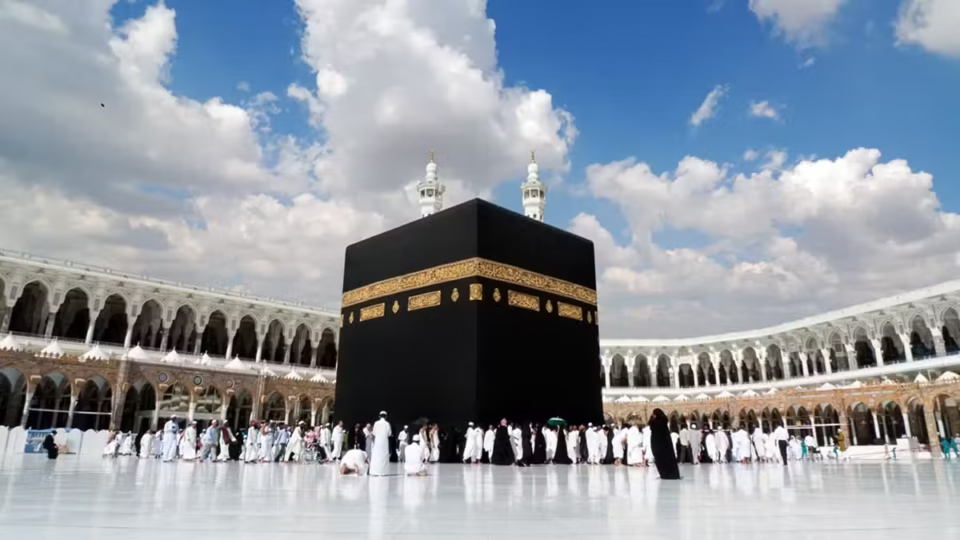
Pakistan Introduces First Multi-Year Hajj Policy for 2027–2030
Pakistan’s Ministry of Religious Affairs and Interfaith Harmony has announced the country’s first multi-year Hajj Policy, covering the period from 2027 to 2030. The new framework is designed to improve planning, enhance transparency, reduce costs, and provide a more organized experience for pilgrims.
Instead of preparing a new policy every year, the government plans to adopt a long-term strategy to improve the management of Hajj operations.
Long-Term Planning for Hajj Operations
Under the new policy, the government plans to secure three- to four-year agreements in Saudi Arabia for key Hajj services, including:
- Accommodation
- Air travel
- Local transportation
- Catering
- Baggage handling
Officials believe long-term contracts will help improve operational efficiency and provide greater stability for future Hajj arrangements.
Hajj Quota Distribution
The overall Hajj quota will continue to be divided between the public and private sectors:
- 60% for the Government Hajj Scheme
- 40% for Private Hajj Operators
Digital Payment System
The policy introduces a fully digital financial system by eliminating paper-based cash transactions.
All Hajj-related payments and financial processes will be handled through the State Bank of Pakistan and integrated digital platforms to improve transparency and convenience.
Hajj Savings Scheme and Advance Registration
A new Hajj Savings Scheme will allow citizens to plan their pilgrimage several years in advance.
Applicants can reserve their preferred Hajj year by depositing 10% of the estimated Hajj cost. Registrations will be processed on a first-come, first-served basis.
Pilgrims under the government scheme will also be able to choose between:
- A 38–42 day standard package
- A 20–25 day short package
Any unused amount remaining after Hajj operations will be refunded directly to pilgrims.
Women Can Perform Hajj Without a Mahram
Under the revised policy, women will be allowed to perform Hajj without a male guardian (Mahram), provided they submit the required official undertaking in accordance with the government’s guidelines.
New Rules for Private Hajj Operators
The government has introduced stricter regulations for private Hajj companies to improve oversight and service quality.
Key measures include:
- Ban on buying, selling, or subletting Hajj quotas
- Mandatory registration with the Securities and Exchange Commission of Pakistan (SECP)
- Required capital reserves
- Digital processing of pilgrim records through the official Private Hajj Management Portal
- A 5% performance guarantee for obtaining a three-year operating license
Companies that fail to maintain a minimum quota of 2,000 pilgrims may lose their operating status. In such cases, affected pilgrims will be transferred to other approved operators.
Mandatory Training for Pilgrims
The policy makes training sessions compulsory for all pilgrims. The sessions will cover:
- Hajj rituals
- Saudi laws and regulations
- Health and hygiene guidance
- Use of official mobile applications
Pilgrim Protection and Emergency Support
A Takaful-based Hujjaj Muhafiz Scheme has also been introduced to provide financial protection.
Each pilgrim will contribute a non-refundable fee of Rs. 1,000.
The scheme includes:
- Rs. 2 million financial support for the family of a pilgrim who passes away during Hajj.
- Rs. 250,000 for emergency medical evacuation when required.
An Emergency Response Team will also be established under the Director-General of Hajj to respond to emergency situations during the pilgrimage.
Policy May Be Updated When Needed
The Ministry stated that the Federal Minister for Religious Affairs will have the authority to update the policy whenever necessary to align with changes in Saudi Arabia’s Hajj regulations or operational requirements.
The new multi-year Hajj framework aims to provide a more structured, transparent, and efficient system while improving services for Pakistani pilgrims in the coming years.
